Role
Everything
FiveDayPage · Independent project · 2026, ongoing
One custom one-page website. Five business days. $1,000, once. No calls, no meetings, nothing for the client to learn. I designed it the way you design a product rather than a project — scope, price, risk and delivery all decided before anyone talks to me. The offer and the site exist. The first customers are what comes next.
Role
Everything
Price
$1,000 flat
Delivery
5 business days
Stack
Astro, Stripe, Netlify
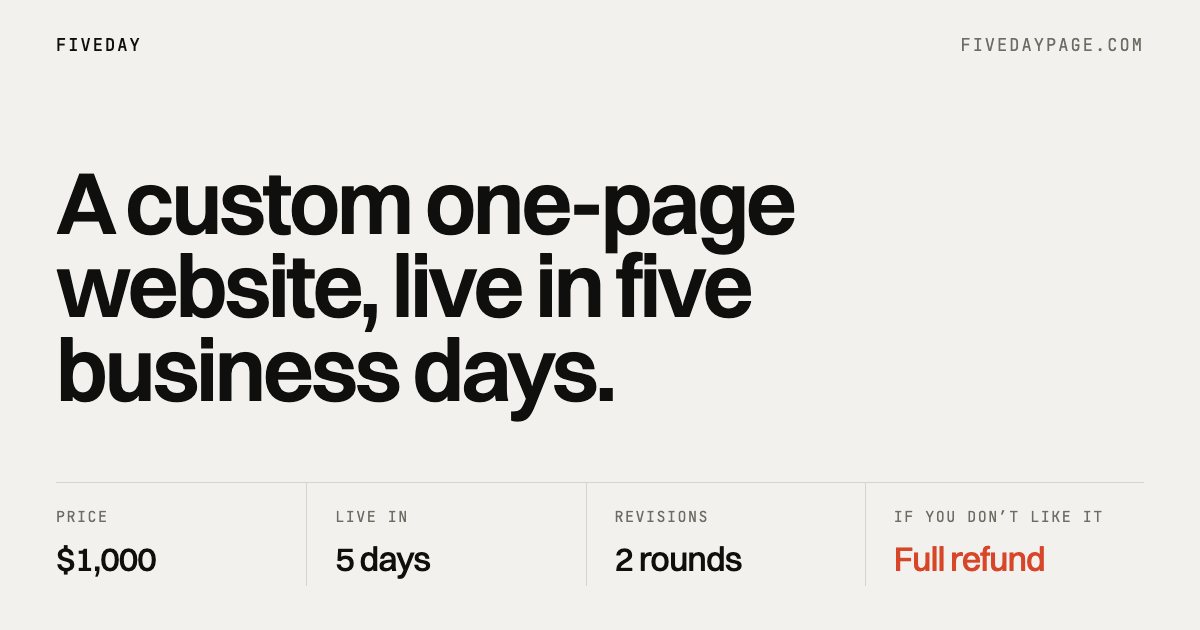
fivedaypage.com — the offer stated in one sentence, with the price in the second.
A small business that needs one page has to sit through a process built for something much bigger: a discovery call, a proposal, a kickoff, a status meeting, an invoice with hours on it, and no idea what it will cost or when it will end.
Most of that exists to manage uncertainty of scope. Remove the scope uncertainty and the whole apparatus becomes unnecessary. So: one page, one price, one deadline, decided before anyone talks to me.
The site is unusually direct about who this is not for: multi-page sites, big catalogues, blogs, and businesses still working out what they sell.
That paragraph does more work than any feature list. It filters out the projects that would break the promise — because a fixed price and a fixed date only hold if the work behind them is genuinely fixed. It is for people selling one thing — local services, a physical location, a solo practitioner, a launch, an event.
The schedule is on the sales page because it is the strongest argument I have. Each day has one deliverable and one decision — and the client's biggest decision comes before most of the money is at risk.
Two rounds of changes are included, each turned around within 24 hours. Updates after launch are $150 per request — priced so nobody has to ask what a change will cost.
“Don't like the design? Full refund.” That single line does the job a portfolio, a testimonials section and a sales call would otherwise have to do together.
It works because of where it sits in the timeline: by Day 1 I have spent a few hours, not a week. The guarantee is affordable precisely because the process is compressed — the operational design and the marketing claim are the same decision.
The kickoff call exists to extract things the client already knows but has never written down: who buys, why they hesitate, what happens after they click.
So the brief asks four questions instead, and the plan for the answers is a model doing what a good designer does in that meeting — following up on the vague answer, noticing the missing one, turning the result into a page plan with a structure and an argument. Fifteen minutes from the client; Day 1 starts with a plan instead of a transcript.
The questions are written. The model reading them is the first thing I will build once there are real answers to read.
The plumbing exists: an Astro template structure, deployment on Netlify, domains and DNS on Cloudflare, Stripe for the single payment. The pipeline is designed end to end — brief, page plan, build, review, deploy — with the repetitive stretches marked as the ones a model should eventually take over.
The automation itself is deliberately not built. Automate what repeats, after it has actually repeated. The first projects get delivered by hand, AI-assisted, and the bottlenecks that show up in real delivery are the ones worth engineering away. Automating an imagined workflow just gets you an efficient version of the wrong process.
The service was designed backwards from what one person plus agents could plausibly deliver in five days — and then priced and promised accordingly. Whether that estimate holds is exactly what the first projects are for.
5
business days from brief to a live page — the promise the whole service is built around
$1K
flat, once — no retainer, no hours, no change-order conversation
0
calls or meetings anywhere in the process, by design
Those are constraints I chose, not outcomes I measured. Nobody has bought one yet.
FiveDayPage is at the point where the product is good enough to test. The next question is not what else to design — it is whether anyone will pay for it. So the next phase is distribution: find the first customers, deliver by hand, and let real delivery decide what deserves to be automated.