Role
Senior Product & Web Designer
Altery · Product & brand · 2025–2026
Altery is an FCA-regulated EMI building multi-currency accounts, cross-border payments and cards across the UK and EU. I owned the web surface end to end — designed it, built it, and wrote the code where the tool ran out — plus the campaigns, events and print around it.
Role
Senior Product & Web Designer
Built in
Framer + custom code
Jurisdictions
UK, EU, Cyprus
Monthly traffic
70K+, roughly doubled
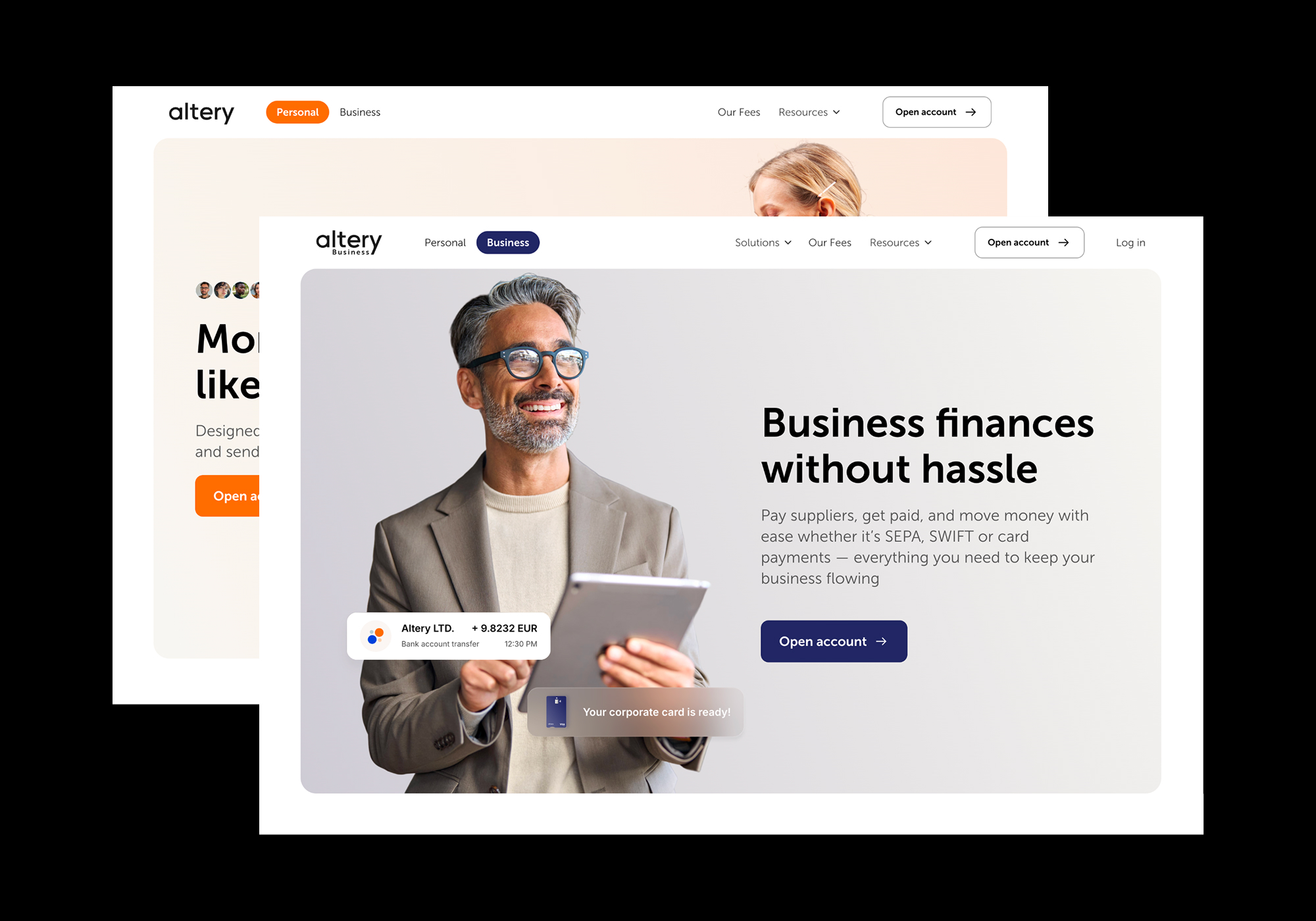
Personal and business, same system behind both. Regulated finance has to look boring in the right way — trustworthy, not timid.
One brand, three regulatory realities. What Altery may offer, promise and even call a product changes between the UK, the EU and Cyprus — and getting that wrong is not a design mistake, it is a compliance one.
This is not a translation problem. Between markets the available services change, and behind them the navigation, the messaging, the terms, the cookie handling and the legal copy all move with them.
Meanwhile marketing needed campaign pages weekly. A site where every locale is a hand-built page collapses under that in a month.



Three of the pages, top to bottom — about, multi-entity accounts, business.
Instead of forking the site per market, availability became a property of the content itself. A block knows where it may appear; a page assembles from what is permitted for the visitor’s jurisdiction.
The payoff is that a new market is a configuration, not a rebuild — and legal review happens once per block instead of once per page. Three were live when I left; the system was built to take more.
United Kingdom
FCA-regulated EMI. Personal and business accounts, UK-specific claims and disclosures.
European Union
SEPA-first messaging, EU entity and terms, feature set gated per licence.
Cyprus
Local entity and content flow, with the same components and none of the copy-paste.
Design did not stop at handoff. I built the site in Framer and wrote code where Framer ran out — custom pagination, and the piece that keeps the careers page filled.
Open roles come from BambooHR through a component I wrote: it fetches the listings, maps their fields onto ours, and exposes the endpoint, the limit and the layout as controls inside the Framer editor. HR posts a vacancy and the site picks it up. Nobody maintains a careers page by hand, nothing sits stale because a designer was busy — and the next person to touch it does not need the code.
The point is not that I can code. It is that a decision could travel from idea to production without a handoff in the middle — which is also where the AI-assisted work in the rest of this portfolio started.
BambooHR, the component, the live page. HR posts a role and the site fills itself.
The most useful page was the one I no longer had to design.
Ten collections in the CMS, each with a template I built — business and personal guides, send-money pages, blog, events, industry, careers, legal. By the time I left there were 148 business guides and 96 send-money pages in there. Nobody hand-designs that many.
Pick a template, fill it, publish. The template also asks for the SEO title and description, so what goes live is finished rather than merely posted.
The work was not the CMS. It was deciding what could safely become a template and what genuinely still needed a designer.
Ten collections, each with a template. The counts do the arguing.
Alongside it I made the paid advertising, the social assets, the motion, the exhibition stands and the print — where the constraints are completely different and the thing still has to read as one company. A claim that fits a landing page has to survive a 300×250 banner and a stand seen from across a hall.
Paid and social, across formats — product claims, partnerships, campaigns and the events themselves.
One of the stands Altery took to the Dubai conferences, visualised here from the artwork. A claim that works on a screen has to survive being read from six metres away.
70K+
monthly visits after the relaunch — roughly double the previous level, across the team’s work
3
jurisdictions served from one component set, with content gated per licence
0
designers needed to publish a campaign page, an article, a guide or an event
The traffic number is a team result — product, marketing and content all moved at once, and I would not attribute it to design alone. The part I would claim is the operational one: new markets became configuration, and new pages stopped needing me.